
This title naturally targets:
- mindfulness exercises
- mindfulness techniques
- reduce stress
- improve focus
- mindfulness activities
- mindfulness for beginners
- mindfulness practice
- present moment awareness
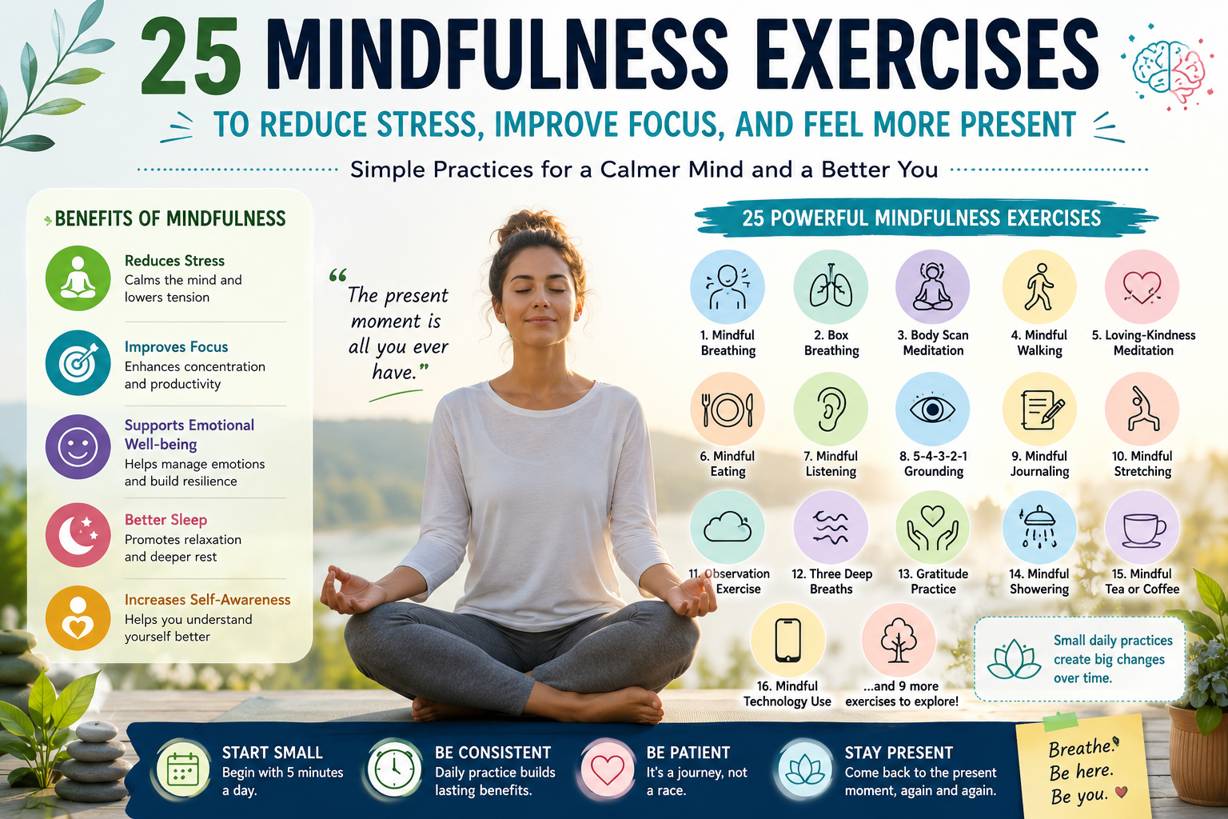
25 Mindfulness Exercises to Reduce Stress, Improve Focus, and Feel More Present
Introduction
Life can feel overwhelming at times. Between work responsibilities, family commitments, social media, and daily challenges, many people find themselves constantly thinking about the future or worrying about the past.
This is where mindfulness exercises can make a real difference.
Mindfulness is the practice of paying attention to the present moment without judgment. Instead of rushing through the day on autopilot, mindfulness helps you become more aware of your thoughts, emotions, surroundings, and experiences.
Research has shown that regular mindfulness practice may help reduce stress, improve focus, support emotional well-being, and increase overall happiness.
The good news is that mindfulness does not require expensive equipment, special training, or hours of free time. Simple mindfulness exercises can be practiced almost anywhere.
In this guide, you’ll discover practical mindfulness exercises for beginners and experienced practitioners alike. These techniques can help you slow down, improve concentration, and feel more connected to the present moment.
What Are Mindfulness Exercises?
Mindfulness exercises are simple activities designed to help you focus your attention on the present moment.
These exercises encourage awareness of:
- thoughts
- emotions
- physical sensations
- breathing
- surroundings
Unlike meditation alone, mindfulness exercises can be practiced throughout the day while walking, eating, working, or relaxing.
The goal isn’t to stop thinking. Instead, mindfulness teaches you to notice thoughts without becoming overwhelmed by them.
Benefits of Mindfulness Exercises
Before exploring specific techniques, it’s helpful to understand why mindfulness has become so popular.
Reduce Stress Naturally
One of the biggest reasons people search for mindfulness exercises is stress relief.
Mindfulness encourages your mind to focus on the present rather than future worries or past mistakes.
Improve Focus and Concentration
Regular mindfulness training helps strengthen attention skills.
Many people notice better concentration at work, school, and daily tasks.
Support Emotional Health
Mindfulness helps you become more aware of emotions without reacting automatically.
This can improve emotional balance and self-awareness.
Better Sleep Quality
Mindfulness exercises before bed can help calm racing thoughts and improve relaxation.
Increased Self-Awareness
The more mindful you become, the better you understand your habits, emotions, and reactions.
Mindfulness Breathing Exercises
1. Basic Mindful Breathing
Mindful breathing is one of the easiest mindfulness exercises for beginners.
How to practice:
- Sit comfortably.
- Close your eyes.
- Focus on your breath.
- Notice each inhale and exhale.
- Gently return your attention whenever your mind wanders.
Practice for 3 to 5 minutes daily.
2. Box Breathing Exercise
Box breathing is commonly used to reduce stress and improve focus.
Steps:
- Inhale for four seconds.
- Hold for four seconds.
- Exhale for four seconds.
- Hold again for four seconds.
Repeat several times.
3. Counting Your Breaths
Count each breath cycle from one to ten.
When your mind wanders, simply start again at one.
This exercise improves concentration and mental clarity.
Mindfulness Meditation Exercises
4. Five-Minute Mindfulness Meditation
A short meditation session can fit into almost any schedule.
Focus only on:
- breathing
- body sensations
- present-moment awareness
Even five minutes can help calm the mind.
5. Body Scan Meditation
Body scan meditation encourages awareness of physical sensations.
Slowly move your attention through:
- feet
- legs
- hips
- stomach
- chest
- shoulders
- arms
- neck
- face
Notice sensations without trying to change them.
6. Guided Mindfulness Meditation
Many beginners find guided meditation helpful because an instructor provides direction throughout the session.
This reduces distractions and makes mindfulness easier to learn.
Mindfulness Exercises for Anxiety
7. The 5-4-3-2-1 Grounding Technique
This mindfulness technique is popular for anxiety management.
Notice:
- 5 things you can see
- 4 things you can touch
- 3 things you can hear
- 2 things you can smell
- 1 thing you can taste
This exercise quickly brings attention back to the present moment.
8. Name Your Feelings
When anxiety appears, pause and identify the emotion.
Examples:
- worried
- frustrated
- nervous
- stressed
Simply labeling emotions often reduces their intensity.
Also read: 175 Funny Questions to Ask
9. Mindful Observation
Choose an object nearby.
Spend one minute observing:
- color
- shape
- texture
- details
This helps shift attention away from anxious thoughts.
Mindfulness Exercises for Stress Relief
10. Mindful Walking
Walking mindfully means paying attention to each step.
Notice:
- movement
- balance
- breathing
- surroundings
Even a short walk can reduce stress.
11. Mindful Stretching
Slow stretching combined with awareness of body movements creates a powerful relaxation practice.
12. Gratitude Mindfulness Exercise
Think of three things you’re grateful for.
Focus on each one for several moments.
Gratitude and mindfulness work well together to improve emotional well-being.
Mindfulness Exercises for Daily Life
13. Mindful Eating
Many people eat while distracted.
Mindful eating involves:
- noticing flavors
- chewing slowly
- appreciating textures
- paying attention to hunger signals
14. Mindful Listening
During conversations, focus fully on the speaker.
Avoid planning your response while they talk.
This improves communication and relationships.
15. Mindful Journaling
Write down your thoughts without judgment.
Journaling helps increase self-awareness and emotional clarity.
16. Mindful Technology Use
Before opening social media, pause and ask:
“Why am I using this right now?”
This simple habit increases intentional behavior.
Mindfulness Exercises for Beginners
17. One-Minute Awareness Practice
Set a timer for one minute.
Simply observe:
- breathing
- thoughts
- sounds
- sensations
This is one of the easiest mindfulness exercises for beginners.
Also read: ENFP Personality Type
18. Mindful Hand Washing
Turn an ordinary task into a mindfulness practice.
Notice:
- water temperature
- soap texture
- hand movements
19. Three Deep Breaths Exercise
Whenever stress appears, pause and take three slow breaths.
This takes less than a minute but can quickly improve calmness.
Advanced Mindfulness Exercises
20. Open Awareness Meditation
Instead of focusing on one thing, observe everything happening around and within you.
Notice thoughts, sounds, and sensations without attachment.
21. Loving-Kindness Meditation
Focus on sending positive wishes to yourself and others.
This practice supports compassion and emotional wellness.
22. Mindful Silence Practice
Spend a period of time without speaking, scrolling, or consuming media.
Simply observe your experience.
Tips for Building a Mindfulness Habit
- Start with five minutes daily.
- Practice consistently.
- Be patient with yourself.
- Avoid judging your thoughts.
- Use reminders throughout the day.
- Focus on progress rather than perfection.
Also read: JJMR Site
Final Thoughts
Mindfulness exercises are simple tools that can help reduce stress, improve focus, and create a greater sense of calm.
Whether you practice mindful breathing, meditation, mindful walking, or gratitude exercises, the key is consistency.
Small moments of awareness practiced daily can lead to meaningful improvements in mental well-being, concentration, and overall quality of life.
The best mindfulness exercise is the one you will actually practice. Start small, stay consistent, and allow mindfulness to become a natural part of your everyday routine.
Frequently Asked Questions About Mindfulness Exercises
What are mindfulness exercises?
Mindfulness exercises are simple practices that help you focus on the present moment. They involve paying attention to your thoughts, feelings, breathing, and surroundings without judgment. Common mindfulness exercises include mindful breathing, meditation, mindful walking, and body scan techniques.
What is the best mindfulness exercise for beginners?
Mindful breathing is often considered the best mindfulness exercise for beginners. It is easy to practice, requires no special equipment, and can be done almost anywhere. Simply focus on your breathing and gently bring your attention back whenever your mind wanders.
How do mindfulness exercises help reduce stress?
Mindfulness exercises help reduce stress by encouraging you to focus on the present moment instead of worrying about the future or dwelling on the past. This can calm the mind, lower tension, and improve emotional balance.
How long should I practice mindfulness each day?
Even 5 to 10 minutes of daily mindfulness practice can be beneficial. Beginners can start with a few minutes and gradually increase their practice time as they become more comfortable.
Can mindfulness exercises help with anxiety?
Yes. Many people use mindfulness exercises for anxiety management. Techniques like mindful breathing, grounding exercises, and body scan meditation can help reduce anxious thoughts and improve emotional awareness.
What is the difference between mindfulness and meditation?
Mindfulness is the practice of being aware of the present moment, while meditation is a specific activity used to develop mindfulness. You can practice mindfulness throughout the day, even while eating, walking, or working.
Are mindfulness exercises scientifically proven?
Research suggests that mindfulness practices may help improve focus, reduce stress, support emotional well-being, and enhance overall mental health. Many healthcare professionals recommend mindfulness as part of a healthy lifestyle.
Can mindfulness improve focus and concentration?
Yes. Regular mindfulness practice trains your brain to stay focused on one task at a time. Over time, this can improve concentration, productivity, and mental clarity.
What are some simple mindfulness activities I can do at home?
Some easy mindfulness activities include:
- Mindful breathing
- Body scan meditation
- Mindful eating
- Gratitude journaling
- Mindful walking
- Deep breathing exercises
- Guided mindfulness meditation
These activities can be practiced from the comfort of your home.
Is mindfulness suitable for children?
Yes. Mindfulness exercises can be adapted for children and teenagers. Simple breathing activities, mindful listening, and gratitude exercises can help children improve focus and emotional awareness.
Can mindfulness help improve sleep?
Many people use mindfulness techniques before bedtime to calm racing thoughts and relax the body. Mindfulness meditation and breathing exercises may help improve sleep quality and support better nighttime relaxation.
How long does it take to see results from mindfulness exercises?
Some people notice benefits after just a few sessions, while others may experience gradual improvements over several weeks. Consistency is the key to getting the most from mindfulness practice.
Can I practice mindfulness without meditation?
Absolutely. Mindfulness can be practiced during everyday activities such as eating, walking, cleaning, working, or listening to someone speak. Meditation is just one way to develop mindfulness skills.
What are the most popular mindfulness techniques?
Popular mindfulness techniques include:
- Mindful breathing
- Body scan meditation
- Mindful walking
- Loving-kindness meditation
- Gratitude practice
- Grounding exercises
- Mindful observation
These techniques are commonly recommended for beginners and experienced practitioners alike.
Why are mindfulness exercises becoming so popular?
People are increasingly searching for natural ways to reduce stress, improve focus, and support mental well-being. Mindfulness exercises are simple, accessible, and can be practiced almost anywhere, making them popular among people of all ages.
Author bio:
Hello, I am a professional SEO Expert & Write for us Technology and submit a guest posts on different platforms- we provide a good opportunity for content writers to submit guest posts on our website. We frequently highlight and tend to showcase guests.