For years, Renee’s dispatch duties involved a white board, radio and just a lot of guesswork about where her technicians were. A customer would call and ask when someone would be there and Renee would get some kind of call out from a tech who didn’t always show up, and she would give an educated guess to the customer. Jobs were double booked, as it was not possible to update the whiteboard in real-time. There was always a two-week delay for invoices to get typed into the system back at the office.
None of that is how her company runs today, and the shift didn’t come from hiring more dispatchers or buying a bigger whiteboard. It came from working with a mobile app development company to build a dispatch and field service tool that put every technician’s location, schedule, and job history on one screen Renee actually sees in real time now. That kind of shift is playing out across small and mid-size businesses well beyond field services right now, because the operational gap between a company running on paper and spreadsheets and one running on a purpose-built app has gotten wide enough that it shows up directly in the bottom line.
Why Generic Software Stops Fitting Past a Certain Point
The generic CRM and scheduling software are the best choice for companies that are just getting started, but they’re meant for supporting many companies simultaneously and don’t necessarily model the way any one company works. Until they decided to go with a custom dispatch system, Renee’s team had been using two off-the-shelf dispatch systems, each had its own idea of what a service call should be and needed the technicians to fit the bill. However, a custom operations application is not created from a template, but from the workflow, job types and reporting requirements of the business.
What Mobile Apps Are Actually Replacing Inside a Business
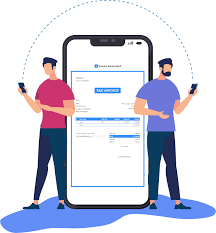
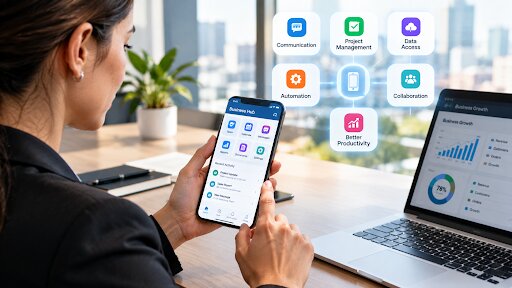
The pattern is manifested in the same way in all industries, regardless of the nature of the used tools. Real-time dashboards replace paper job tickets and whiteboards. A common spreadsheet for inventory is replaced by a mobile application that automatically updates inventory as a technician removes a part from the truck. Push notifications and in-app messaging replace phone-tag with the field staff and the office, and capture all the communications instead of depending on a person’s recollection of a phone call. What used to be a paper invoice in a truck cab for 2 weeks is replaced by an application where a technician creates and sends an invoice from the job site, before they even leave the driveway. There are no such spectacular changes here. One by one they fill the gap where information is lost, delayed or misremembered. Multiply enough of those back-and-forths over a year, and they begin to add up as missed appointments, duplicate orders, and customers sneaking away to another competitor after one too many scheduling snafuckas.
Where the Real Return Shows Up
The value of a business operations app rarely comes from a single dramatic feature. It comes from compounding small efficiencies across every job, every shift, every week. A dispatcher who can see every technician’s real-time location schedules more efficiently and books more jobs into the same working day. A technician who can pull inventory data from his phone doesn’t waste a trip back to the warehouse for a part that wasn’t actually in stock. A business owner who can see completed jobs, revenue, and technician performance on one dashboard makes decisions off real numbers instead of a gut sense of how the week went. Individually, each of these looks like a minor convenience. Across a full year of operations, they add up to meaningfully more jobs completed with the same headcount.
What Actually Determines the Price of a Build
Mobile app development cost for an operations tool depends heavily on how many existing systems it needs to connect to, since integrating with accounting software, existing inventory databases, or payment processors takes considerably more engineering work than building a standalone app with no outside dependencies. Real-time location tracking and offline functionality, both essential for a field service team working in areas with spotty signal, add their own layer of complexity beyond a simple scheduling interface. A single-location business with a handful of employees needs a much smaller build than a company coordinating dozens of technicians and multiple warehouses, and most of that added cost lives in the integration and data-syncing work rather than anything visible on the app’s home screen.
What Changed for Renee’s Team
Renee still runs dispatch, but she’s not guessing anymore. She can see exactly where every technician is, exactly which jobs are running long, and exactly which parts are actually on a truck before she promises a customer same-day service. Invoices go out the same day a job finishes instead of sitting in a cab for two weeks, and double-booked jobs are rare enough now that they’re worth mentioning when they happen. The whiteboard is gone from the office wall. What replaced it isn’t a flashier version of the same idea, it’s a system that actually reflects what’s happening in the field in real time, which is the thing the whiteboard was always trying and failing to do. The whiteboard was never the problem itself, it was just the clearest symptom of a business running on guesswork instead of real information.