
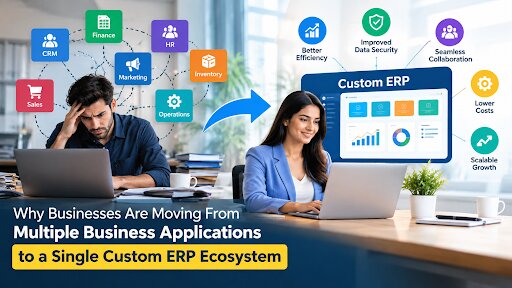
Most companies did not set out to create a fragmented tech stack. They made the rational choices — a CRM here, an HRMS there, a project tool that their ops team preferred at the time. Each choice solved a real problem. Then came the integrations — APIs, middleware, automation connectors, syncing schedules. On paper, they were talking, but in practice something was broken.
Partnering with a custom ERP software development company will help you ask more than just “how do we connect these tools?” It will ask you, “why are we paying to maintain a system that was never designed to work as one?” That question is the topic of this post.
The Multi-App Stack Looked Like a Solution. It Wasn’t.
Between 2015 and 2022, the most modern, innovative SaaS was the dominant way to source enterprise software. Enterprises replaced bulky legacy ERPs with custom-built tools — separate applications for sales, HR, finance, project delivery and customer service. Each app excelled at its job. That was the selling point.
The assumption of every integration project was simple: connect the inputs and the stack functioned as one. Middleware, iPaaS tools, and custom API layers made it look easy. And for a time, it worked well enough.
Getting the tools to work effectively doesn’t result in coherence in the system. They use different data models, definitions and logic. Connecting them creates a translation between two architectures never meant to be aligned.
Integration debt is derived from the software engineering term technical debt. Integration debt is the cumulative burden that occurs when businesses patch together systems that share logic, not just data. It grows quietly. It doesn’t show up on the invoice of a vendor. And unlike a slow application or a broken feature, it has no owner.
What Integration Debt Actually Costs Businesses
The visible costs can be quite palpable: API maintenance fees, middleware licensing, developer hours spent on break-fix work after a vendor update — frustrating but quantifiable. Integration debt is the actual destruction of the hidden costs.
Data inconsistency at the seam is the most subtle. Two systems can be synced perfectly and still output contradicting results. A deal marked “closed” in CRM does not automatically mean revenue has been earned in finance. Each system applies its own logic to the same event. The reports are different downstream, and nobody is wrong. The data moved correctly; the interpretation did not.
Workflow translation labor is the cost that never appears on any software contract. These are the workers who act as human middleware — pulling a report from one system, reformatting it, and manually entering it into the other because the integration handles the data but not the process. This labor is invisible, unrecorded, and normalized as “just how things work here.”
Update fragility often manifests at the worst moments. Each vendor update introduces regression risk to every integration consuming the API from that vendor. Businesses running connected stacks are in a state of dependency management. There is no clear owner when something breaks at the seams. There is a conversation between vendors pointing fingers at each other.
For companies that have spent substantial sums on these integrations, the temptation is to look back and re-evaluate. The cost of the connectors becomes a psychological deterrent to re-evaluate. The wasted money seems like a reason to go on. Connectivity is not the same as coherence. The tools are translating. They are not understanding.
Why “Connected” and “Unified” Are Not the Same Thing
The difference is not only architectural, but also conceptual.
Connected stack moves data between systems via rules. Each application has its own data model, governance structure, and logic. Relationships between systems are maintained externally using middleware, scheduled syncs, or custom code.
One unified system is operated from one data model. Sales, HR, finance, operations all draw from and write to the same data model. There is no translation because there is no boundary. Logic applied to one function becomes available to all others.
Where the Gap Shows Up in Real Operations
Reporting is the most common area of failure. For a connected stack, data can come from three or four sources, with conflicting data, and the output is slightly stale by the time it comes out of the box. For a unified stack, data is pulled from one layer with no reconciliation.
Cross-functional automation fills the next gap. It sounds easy to trigger a billing action when a project milestone closes. In a connected stack, it requires middleware choreography — a trigger in one system, a webhook to another, a conditional rule to the third, and error handling at every possible breakpoint in the chain. In a unified system, it is a native workflow rule.
The third pressure is audit and compliance. As I discussed, constructing a transaction trail across multiple systems is a forensic exercise. Transaction logs exist in different places, formatted differently, and there is no guarantee that one system is always connected to another. A single system maintains a consistent record because the transaction never left the system.
What a Custom ERP Ecosystem Actually Resolves
The most common objection at this stage is legitimate: “We evaluated ERP before and it didn’t fit how we operate.” That objection is almost always directed at off-the-shelf platforms — systems built around generalized workflows that businesses are expected to adapt to.
Custom ERP software solutions India development inverts this entirely. The system is architected around the business’s actual operational logic, not vendor assumptions about how a business should run. That distinction is not cosmetic. It is precisely what makes a custom ERP ecosystem solve what connected stacks cannot.
Three specific resolutions follow from this architecture.
First, there is no middleware to install and maintain, no scheduler or field mapping logic to replace after a vendor update. Data is native to one system and is interpreted by one set of rules.
Second, the logic of the process is embedded in the system. Workflows for approval, rules for handling exceptions, and handoffs between departments are built into the system, not tacked on top with hacks that break when the application itself updates.
Third, all of the failures can be found by one vendor. One system owner. One central point to look for and resolve a failure in a linked stack. If a stack is broken, the failure is caught between vendors who have little visibility into each other’s systems. In unified ERP, the failure has an address.
When you choose a custom ERP software development firm that recognizes this difference, you are not buying software. You are making an architectural decision. Every process improvement in your new system will continue to grow across all of your business functions, because the system is only one.
The Right Time to Recognize Integration Debt
Vier signals indicate that integration debt has moved from manageable friction to structural risk.
- Reports from different systems may report different numbers for the same metric. The team has come to expect this.
- A vendor update in the last 12 months required development assistance to fix a broken integration.
- Workflows between finance, operations, and sales are validated with a human touch to ensure the accuracy of data before the next step can be taken.
- Leadership decisions are delayed because stakeholders cannot agree on which system contains the true version of a key metric.
These are not symptoms of poor software selection, they are symptoms of architecture that has reached its ceiling. Recognizing that ceiling is the first thing that a business can do.
Partner With Arobit to Build an ERP Ecosystem That Actually Works as One
No, the companies who have invested in integration layers are not failing because they made bad technology choices. They are failing because connectivity was never designed to replace architecture. The gap between connected stack and unified system is not a feature gap, it’s structural and patching it with more middleware will only add to that cost.
Arobit provides custom ERP software solutions designed around your business logic, not in the generic template. Arobit, a trusted top custom ERP software solutions India provider, delivers complete ERP systems with every function sharing one data layer, one governance model, and one accountability layer. It’s not a better-connected stack; it’s a system that is a single coherent entity — and all processes run inside it.
Frequently Asked Questions
- What exactly is integration debt, and how is it different from technical debt?
Technical debt refers to shortcuts taken within a single system that ultimately need to be corrected, while integration debt refers to the load on multiple independently built systems when they are connected outside. The cost is not in the code of any specific application, but in the maintenance, fragility and inconsistency between them. It is cumulative and it has no single owner.
- Our integrations are working fine right now. Why should we be concerned?
Connected integrations rarely fail all at once. They gradually degrade with data inconsistencies that become normalized, manual workarounds that become permanent, and update issues that get more frequent as the stack matures. By the time integration debt is disruptive, the cost has been accumulating for months or years.
- Why can’t we solve this by switching to a better middleware or iPaaS platform?
Middleware improves the reliability of data movement between systems, but it does not address the underlying architecture problem. Each system in the stack is still working off its own model and logic. A more capable middleware layer produces cleaner translations and not a single interpretation. The inconsistencies at the seam do persist because the seam is there.
- How is a custom ERP different from an off-the-shelf ERP when it comes to solving this problem?
Off-the-shelf ERPs consolidate tasks into a single platform, but only based on the vendor’s premade process logic. Businesses must adapt workflows to fit the software. A custom ERP software solutions India product is designed to be based on your business’s existing process logic, approval workflow, and data definitions. There is no layer of translation or compromise in the workflow. The unification is complete because the system was designed for that particular business.