
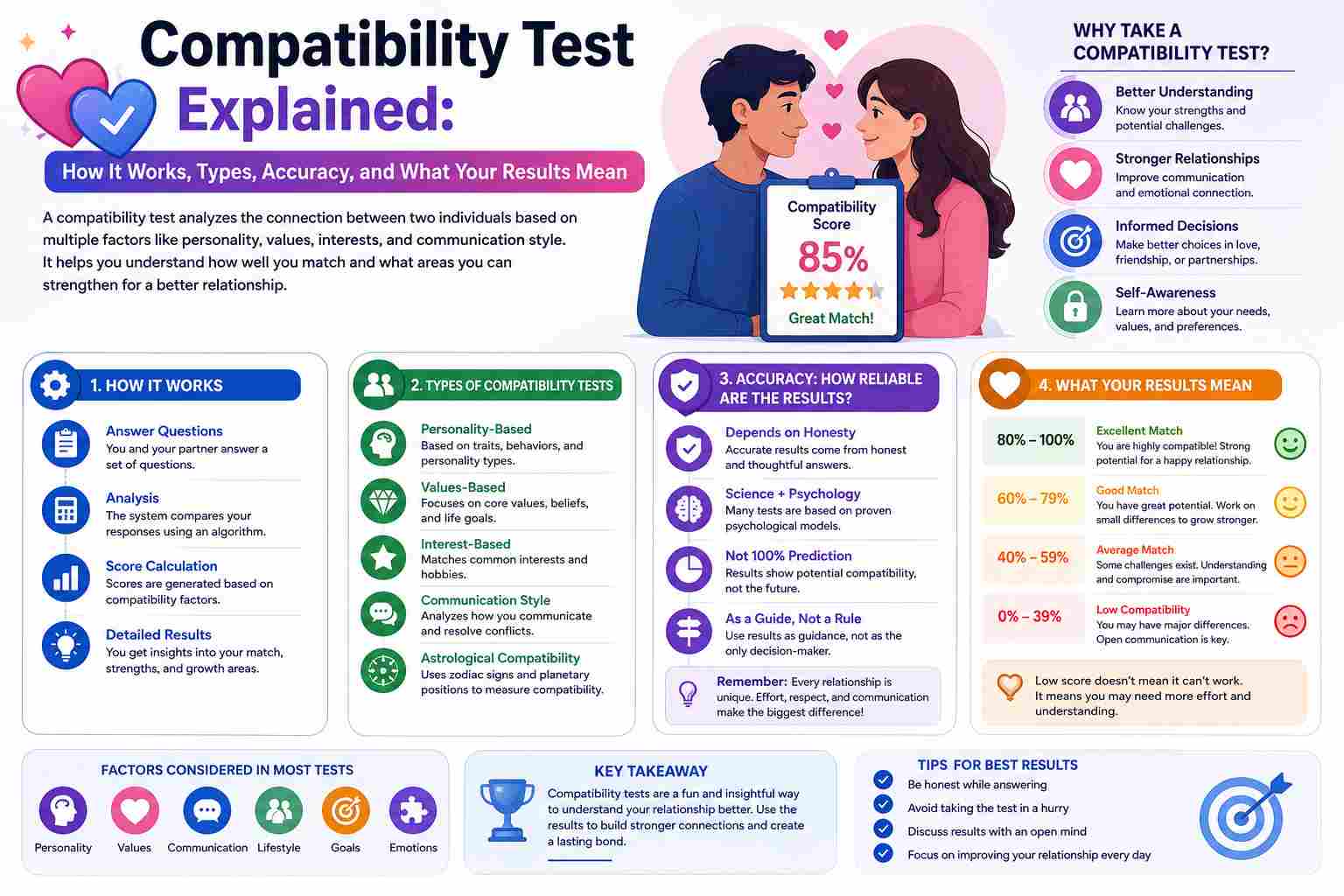
How Compatibility Tests Work: Types, Accuracy, and What Your Results Mean
From work relationships to your personal relationships, each one is what makes life worth living. Each type of relationship is made up different things, such as communication, trust, common values, understanding emotions, and respect. There is one part of every relationship that people always seem to wonder about. While people know that they should make long term commitments to people that are truly compatible with them, how do people know if they are truly compatible with another?
That is why so many people search for compatibility tests. There are many assessments that are designed to help people learn their personality, communication styles, and needs on emotional levels to help them find people with similar interests. Some retreat to tests that evaluate romantic relationships, while others evaluate friendships, workplace relationships, and general personality fits.
Currently, there are almost a thousand websites that claim to offer a free compatibility test to see how well two people fit together. Many of these tests base their assessments upon personality psychology, while others are based upon question assessments with communicates habits and emotional intelligence, values, and lifestyle preferences.
But the main question is, do compatibility tests actually tell you the future of your relationship?
The answer is really not that simple.
Human relationships thrive on trust and respect along with emotional commitment and growth, which is hard to measure in the short form of a questionnaire, and therefore, cannot predict the future.
This guide is about how and why compatibility tests are performed, their types, their reliability, and some suggestions on how to use their results appropriately.
What Are Compatibility Tests?
A compatibility test assesses the personalities, preferences, values, interests, or behaviors of two persons and looks for alignments and omissions. They do not determine if two people are or are not compatible. Instead, they aim to show patterns that could potentially influence a relationship.
The assessments can be about:
- Personal values
- Emotional needs
- The style of a person’s communication
- Hobbies and interests
- How a person makes decisions
- How a person resolves conflicts
- What goals a person has for their life
- What a person’s personality is
Results of such assessments often help peers and persons understand themselves and their relationships.
Compatibility tests are used by all sorts of combinations of people from friends, families and couples to career counselors and employers.
Why Are Compatibility Tests Used?
There are numerous reasons why people opt for taking a compatibility test.
Many people who are just starting a relationship take compatibility tests to see how their perspectives align.
Some people have taken compatibility tests to improve communication in a long-term relationship.
Some people take tests for no reason other than novelty.
The common reasons people take various compatibility tests are:
- Trying to understand a romantic relationship
- Communication improvement
- Personality differences
- Preparing for a marriage
- Getting to know people better and enhancing relationships
- Improving workplace relationships
- Understanding oneself and personal development
- Novelty and curiosity
Although results can be of interest, they often help initiate discussions rather than serve as the basis for judgment.
How Do Compatibility Tests Work?
These types of tests provide results by asking a series of questions to multiple participants, then comparing the responses.
The questions can be about:
- Communication
- How you like to spend your time
- Your opinions about money
- What you think your relatives should be like
- How you like to show/not show your feelings
- What you want to happen in the future
- What things you like to do
- What happens if someone annoys you
Once both participants answer the questions (or one participant answers the questions about both participants in a pair) the system responds.
Some tests tell you your score and what percentage of compatibility you have.
Other tests tell you describe what is good, what is not good, and how you and your partner could improve.
More advanced personality-based assessments compare psychological traits instead of just counting matching answers.
The more scientific a test is, the better results you should get.
Compatibility Isn’t About Being The Same Person
Popular thinking has made people assume that compatibility takes two people having the same personality.
Psychology has shown the opposite and considered how effective relationships are because of how participants embrace opposites.
Some of the other things we have seen include:
- Communication
- Being supportive
- Working towards similar goals
- Respect
- Commitment
- Being flexible
Some of these opposites can help strengthen a relationship.
One person can enjoy planning while their partner can enjoy being spontaneous.
Neither of these two methods of thinking are better or worse to each other.
For a relationship to thrive, each person must understand and accept their differences.
How Compatibility Tests Are Done
Not all compatibility tests are the same.
Depending on what kind of relationship is being assessed, various tests can have varying focuses.
Some focus only on relationships.
Others focus on personality only.
Some focus on communication styles. Others focus on shared values. Understanding the difference helps us know which assessment to recommend to a prospective client.
Common categories include:
- Relationship
- Love
- Personality
- Friendship
- Marriage
- Workplace
- Lifestyle
Each category covers different dimensions of interpersonal interaction.
Relationship Compatibility Test
A relationship compatibility test helps individuals understand their ability to work within the context of a long-term relationship.
These assessments examine more of the relationship’s everyday dynamics rather than the kind of temporary relationship driven by physical attraction.
Some examples of these dynamics include:
- Communication
- Resolve conflict in a way that works for both of you
- Value the same things when it comes to your family
- Have the same expectations when it comes to your finances
- Give support when times are tough
- Trust each other
- Plan together for the future
- Have the same goals for your future
- Personal priorities
Rather than telling you if a relationship will work, these tests show you if a couple is compatible in a given dimension and in what way, to what extent, and to what degree they may work well together.
Many relationship counselors stress that these assessments should be a starting point for a conversation rather than a final word.
Love Compatibility Test
The love compatibility test, as one of the most popular assessments, is focused on the emotional and romantic attraction someone feels.
Some of the questions in these assessments may include:
- Expectations of emotional needs
- How often you would like to be physically affectionate
- Preference of quality time
- How you would like to communicate with each other when you disagree
- Your goals for your relationship
Some of these assessments have add-ons to ask for the name, birthday, and even your Zodiac sign to give you an answer that is more “custom”.
These are mainly for entertainment value and lack science. Psychology-based relationship assessments will provide insights that are more valuable.
Personality Compatibility Test
A personality compatibility test is not as widely focused on the dimension of romance as some of the other assessments, and therefore covers a wider spectrum
These assessments examine:
- Introversion and extroversion
- Preference in making decisions
- Emotional control
- How well a person is organized
- Their level of creativity
- How people choose to lead
- Behaviors
- How well a person manages stress
How people view their personalities, and how compatible they think they are, can provide insight to how compatible they are in their relationships. This includes friendships, families, and even work.
Being able to identify particular personality traits can help prevent communication gaps and create clearer paths of understanding.
Free Compatibility Tests: An Overview
You can understand the relationship dynamics of your preferred work colleague, friendship, or romantic partner, along with your preferred emotional styles, personality types, and communication styles, with a professional compatibility assessment. But, they charge. Compatibility tests that are free help you understand the relational dynamics and personality traits, and communication and emotional preferences of multiple types of relationships, like romantic and work, as well as friendships, self-discovery, marriage prep, and dating.
In contrast to traditional compatibility assessments that require a lengthy professional evaluation, results are generated in a matter of minutes after the completion of a short questionnaire. Some tests compute a relational compatibility score, while others offer a comprehensive relational analysis outlining the relational strengths and weaknesses, and comprehensive suggestions for the relational improvement. Most free compatibility tests fall within a spectrum of a constructive psychological model to a mere critique of entertainment. Important to note is that the results of free compatibility assessments should be taken with a grain of salt.
An Online Compatibility Test
Compatibility assessments in an online format have completely transformed the traditional in-person model of therapy. Answering a series of questions with a psychotherapist can take hours, but now the same can be done in a matter of minutes with an automated system. A compatibility assessment is online in a matter of hours because of the convenience of modern technology. The assessments can be done from almost anywhere, even from the privacy of your own smartphone.
Personality-Based Compatibility Tests
Most modern compatibility assessments employ the science of personality psychology to a large extent as compared to traditional models of compatibility that relied heavily on matching questions.
Asking whether two people have similar hobbies is the simplest way of determining if two people will get along. But many people take this further. They consider how people of different personalities would behave differently in a variety of situations.
Some of these behaviors include:
- How they choose
- How they manage emotions
- How they express themselves
- How they relieve and manage stress
- How they lead
- How they interact socially
- How they solve problems
Analyzing this behavior is more valuable than asking what their favorite movie or food is.
MBTI Compatibility
More often than not, the personality model that is referred to for compatibility is the Myers-Briggs Type Indicator (MBTI).
MBTI is a personality model that identifies 16 different personality types along 4 different psycho-social spectrums:
- Introverts vs. Extroverts
- Sensors vs. Intuitors
- Thinkers vs. Feelers
- Judgers vs. Perceivers
Analyzing communication styles and interpersonal relationships is often done through the lens of personality types.
For example:
- An introvert needs quiet time to recharge.
- An extrovert spends time in the social realm to recharge.
Neither is true or false. Knowing where your partner stands is what helps you understand them better.
It is very important to note that, while MBTI is the most common self reflection and workplace personality development model, the validity and reliability of this model is still up for debate.
Enneagram Compatibility
Another common personality model is the Enneagram.
The Enneagram is the model that describes the most personality types (9) in relation to the psychology of their fears, behavioral motivations and desires.
This model is unique in that it encourages you to grow and understand where your emotions are coming from.
Couples love exploring their Enneagram compatibility because it addresses Emotional needs, Conflict, Stress, Relationship Expectations, and Growth.
While the Enneagram is incredibly popular, it is important to remember that it should be used for self-awareness first rather than predicting if your relationship will be successful.
The Big Five Personality Model
The Big Five Personality Model is one of the leading personality frameworks, especially among psychologists, as it gives a unique way of analyzing personality without boxing individuals into specific groups.
The five dimensions of the model are:
- Openness
- Conscientiousness
- Extraversion
- Agreeableness
- Neuroticism (which is generally referred to as emotional stability)
The Big Five tends to have more empirical evidence backing it, compared to many of the other personality tests, thus a lot of researchers prefer using it in their scientific studies.
Some of the compatibility tests use the Big Five dimensions to find out how people’s personalities are likely to develop over time.
For instance,
- Agreeableness is often associated with a higher likelihood of collaboration.
- Conscientiousness can be linked to a greater degree of trust.
- Emotional stability can also be linked to a greater degree of trust and improved management of conflicts.
Again, it has to be noted that these are likely trends, and not certainties.
Emotional Compatibility
Aside of attraction, there are other key elements that can determine the success of a romantic relationship.
An important element, that can affect the satisfaction of a relationship, is emotional compatibility.
Emotionally compatible partners:
- Feel that they are understood.
- Feel free to show their emotions.
- Value each other’s emotions.
- Address differences in opinion with maturity.
- Provide support when the other partner is experiencing difficulties.
The quality of a relationship can be affected by the emotional connection, and thus some compatibility questions may be focused on emotional connection along with emotional and self-awareness communication.
Communication Compatibility
Communication has consistently proven to be one of the most important elements of a healthy relationship.
Two partners, even if they have completely different personalities, can build a successful relationship if they communicate well.
Some of the common elements of communication that may be evaluated in a compatibility test include:
- Ability to listen
- Conflict resolution and management
- Emotional honesty
- Respect
- Problem solving
- Ability to compromise
The most prominent sign of a relationship’s incompatibility is lack of communication.
However, this can be improved through deliberate efforts to strengthen communication.
Lifestyle Compatibility
The way your lifestyles align or don’t impact your long term happiness.
Some compatibility tests include questions about:
- Spending habits
- Career Priorities
- Travel Interests
- Health and Fitness
- Daily Routines
- Social Activities
- Family Planning
- Religious or Cultural Practices
Lifestyle differences aren’t good or bad. But identifying differences can help couples set their expectations to avoid the negative effects of miscommunication.
Of the Values and Goals
Many relationship experts say that shared values and goals are more important than shared interests.
Two people can have a wonderful relationship if they both have similar values, even if they enjoy different interests.
Some of the values and goals that compatibility tests cover include:
- Marriage
- Family
- Finances
- Career
- Values
- Education
- Parenthood
When couples values align, it is particularly easy for them to make long-term plans together.
While the absence of values can lead to the need for more discussions and compromise, a relationship can still be successful.
Can Opposites Attract?
The concept of opposites attracting is very old.
The truth is likely much more balanced.
People tend to initially be attracted to those with complementary traits. But for long-term successful relationships, it is less important to have opposing traits and much more about how differences are dealt with.
The most successful couples tend to:
- Respect differences
- Communicate
- Support Growth
- Resolve Conflicts in a Respectful Way
- Endure Long-Term
- Share Important Values
Compatibility tests are meant to highlight these relationships and their dynamics, rather than finding perfect matches.
How Accurate Are Compatibility Tests?
Can compatibility tests predict successful relationships? The answer is they cannot.
Smart tests can survey people to recognize communication styles, emotions, and values. Knowing this information can help people understand one another more, but tests cannot predict the future.
Relationships also require the following:
- Trust
- Communication
- Respect
- Emotional maturity
- Commitment
- Life experiences
- Personal growth
- External circumstances
For example, high compatibility scores may still lead to poor communication and unresolved conflict. On the other hand, a couple with very different conflict styles may have a positive relationship since they respect and work with each other.
Compatibility tests should be viewed more as tools for self-awareness.
What Psychology Says About Compatibility
Modern psychology of relationships believes that a truly successful relationship involves healthy behaviors over a perfect personality match.
Research shows the highest levels of relationship satisfaction is present in couples who express personal growth over personality similarity.
Some psychological factors of healthy relationships are:
- Emotional intelligence
- Mutual respect
- Active listening
- Trust
- Flexibility
- Long-term goals
- Healthy conflict resolution
- Empathy
Many compatibility tests focus on these areas when evaluated.
Scientific vs. Entertainment Compatibility Tests
Unlike many psych research-based examinations, most compatibility tests cannot be classified as ‘scientific’ or ‘entertainment’ catalogs.
Scientific Assessments
Scientific assessment-based compatibility tests differ each other by the form of psychological groundwork they stem from. They evaluate one or several of the following: personality, needs, communication, and behavioral tendencies.
Some examples of assessment-based compatibility tests include:
- The Big Five Personality Traits
- Assessments of emotional intelligence
- Communication styles
- Relationship psychology
- Attachment theory
Such assessments typically provide greater meaning and insight as they evaluate behaviors that affect real-life relationships.
Entertainment Quizzes
Most of many online assessments are designed for fun, i.e., entertainment.
Some examples are:
- Name compatibility
- Birthday compatibility
- Zodiac matching
- Color preference
- Love calculators
Although these entertainment compatibility tests can be fun, they’re usually based on little to no science.
Therefore, they ought to be considered fun, and not guidance or advice.
Benefits of Taking a Compatibility Test
In spite of the many constraints and limitations, compatibility tests taken for the right reasons, and under the correct context, can be very good and even beneficial.
One such reason is that they help gain insight and increase awareness, and even provide guidance in dealing with and understanding the differences in personalities, behavioral tendencies, and emotional awareness.
Some other benefits include the identification and discussion of:
- Challenges and issues that may be extremely important and useful to raise while enhancing the quality of your relationship.
- The insight and awareness of other people and encouraging growth and development, and greater empathy.
Compatibility tests do not replace the need for open and honest dialogue. In many situations, they encourage and promote such discussions.
Limitations of Compatibility Tests
Compatibility tests, while providing numerous benefits, have important constraints and limitations.
One such constraint is that people are not static. Rather, the dynamic nature of people is a reality and is based on the fact that people change over time.
As we move through life, our personality continues to shape and shift through our experiences, our relationships, education, our careers, and through our own personal growth.
A compatibility result reflects one’s recent responses and does not predict the future.
Beyond this, there are other limitations:
- Responses can be influenced by factors such as the mood of the respondent.
- Some online tests are not supported by evidence.
- Responses can be interpreted subjectively based on one’s culture.
- Relationships cannot be fully described by a simple percentage.
Knowing these limitations can help people understand results better.
Debunking Myths of Compatibility Tests
There are a number of myths associated with testing for compatibility.
Myth 1: High Compatibility Scores = Positive Outcomes
A high score on a compatibility test does not equate to a successful outcome of a relationship.
The trust, effort, and communication that are fundamental to healthy relationships must be maintained throughout.
Myth 2: Low Scores = Relationship Failure
A low score simply means the two people in the relationship are different.
Many relationships are successful and healthy even when the two people are different.
Myth 3: Perfect Couples Never Disagree
Healthy relationships can disagree.
The measure of compatibility is the manner in which relationship partners contend and resolve conflict.
Myth 4: Opposite Personalities Never Work
Relationships can work with partnerships of different personalities.
Often the differences can create strengths in the relationship if respectful communication is maintained.
Myth 5: Compatibility Never Changes
As individuals move through different life stages and change, relationships can also evolve and change.
Common Misguided Approaches
Compatibility Results as Absolute Truth
Compatibility results for some are treated as absolute.
Some are primarily focused on the final score of the test.
However, the rationale and the explained reasoning associated with the score are often more important and informative than the score itself.
Dishonest Responses
A few participants respond to questions based on who they want to be rather than how they actually act.
Meaningful responses tend to produce more meaningful results.
Disregarding Communication
High compatibility scores cannot substitute for meaningful discussions.
Among other important aspects, the presence of effective communication increases the likelihood of a successful relationship.
Measuring All Relationships Against Each Other
Each relationship functions on its own.
Measuring the results against your family and friends will rarely be beneficial.
Interpreting Results of Compatibility Tests
Viewing a compatibility report should most often be considered a beginning to a discussion.
Instead of asking:
“Are we compatible?”
Ask:
- Where are the strong areas of our relationship?
- Where are the areas of our relationship that we can discuss to help facilitate our growth?
- What are the areas that we can discuss to clarify expectations?
This way of viewing the results of a compatibility test encourages growth rather than a more detrimental score-based evaluation.
Selecting an Online Compatibility Test
When searching for an online compatibility test consider looking for:
- Tests that describe the structure of the test to the taker.
- Tests that describe principles of modern psychology that the test is based on.
- Tests that describe principles of communication and values that the test is based on.
- Tests that describe principles of self-reflection.
Avoid websites that claim they can predict your future relationship with complete certainty.
Healthy relationships cannot be reduced to a single score.
Practical Results of Compatibility Tests
Compatibility tests are not limited to dating.
Compatibility tests are also used in:
- Marriage counseling
- Career counseling
- Team building
- Friendship evaluations
- Personal growth
Cohesion in teams and workplaces can also be achieved by the use of compatibility tests.
These examples imply that compatibility is more about understanding a person and less about guessing who they will fall in love with.
Does Compatibility Change Over the Years?
Compatibility is not fixed. It changes as people grow, gain new experiences, and improve their communication.
For example, a couple with different communication styles can build a stronger relationship over time by listening to each other, being honest, and making compromises.
The same is true for friendships and business relationships. Strong relationships develop when people understand each other’s expectations and respect their differences.
A compatibility test only reflects your current situation. The future of a relationship depends on trust, respect, communication, and consistent effort.
Tips to Improve Compatibility
No matter what your compatibility score is, you can always improve your relationship.
Practice Honest Communication
Talk openly about your thoughts and feelings while respecting the other person’s opinions.
Listen Carefully
Pay attention to what the other person is saying and try to understand their point of view.
Respect Differences
Everyone is unique. Accepting differences can make a relationship stronger.
Build Trust
Be honest, reliable, and keep your promises to build lasting trust.
Spend Quality Time Together
Sharing meaningful time together helps strengthen your bond.
Resolve Conflicts Calmly
Disagreements are normal. Focus on solving problems instead of blaming each other.
Support Personal Growth
Encourage each other to achieve personal goals and grow together.
Should You Take More Than One Compatibility Test?
Different compatibility tests measure different things.
Some focus on personality, while others focus on communication, emotions, or values.
Taking more than one well-designed test can give you a better understanding of your relationship. However, honest conversations are always more valuable than test scores.
When Compatibility Tests Are Most Helpful
Compatibility tests can be useful when you:
- Starting a new relationship
- Preparing for marriage
- Attending pre-marital counseling
- Improving communication
- Solving relationship problems
- Strengthening friendships
- Building better workplace teams
Final Verdict
Compatibility tests are useful for learning more about yourself and your relationships.
They can help you understand personality traits, communication styles, and emotional needs.
However, they cannot predict whether a relationship will succeed.
Strong relationships are built through trust, respect, communication, honesty, and commitment.
Use compatibility test results as a guide for discussion, not as a final decision.
Conclusion
Compatibility tests can show your relationship’s strengths and areas for improvement, but they cannot measure every part of a relationship.
Healthy relationships depend more on trust, communication, respect, and mutual support than on any compatibility score.
Take compatibility tests to learn more about yourself and improve your relationships, not to predict the future.
Frequently Asked Questions
What is a compatibility test?
A compatibility test compares two or more people based on personality, values, communication, and behavior.
Are compatibility tests accurate?
They cannot predict the future of a relationship, but they can provide useful insights.
What is a relationship compatibility test?
It measures how two people match in communication, trust, emotional support, conflict resolution, and future goals.
What is a love compatibility test?
It focuses on emotional connection, affection, relationship expectations, and shared values.
What is a personality compatibility test?
It compares personality traits, communication styles, and preferences between people.
Are free compatibility tests reliable?
Some are based on psychology, while others are mainly for entertainment.
Can online compatibility tests predict marriage success?
No. They only provide insights and discussion points, not predictions.
Can people with different personalities have successful relationships?
Yes. Respect, communication, and commitment are more important than having similar personalities.
Does compatibility change over time?
Yes. Compatibility can improve as people grow, communicate better, and build trust.
Should both partners take the test?
Yes. Honest answers from both people usually provide more meaningful results.
How long do compatibility tests take?
Most online compatibility tests take between 5 and 20 minutes.
Can compatibility tests improve friendships?
Yes. They can help friends understand each other better and improve communication.
What affects compatibility?
Values, communication, trust, emotional intelligence, goals, lifestyle, and conflict-resolution skills all affect compatibility.
What is the best compatibility test?
The best tests are based on psychological research and provide clear explanations instead of only giving a score.
Should relationship decisions depend only on compatibility test results?
No. Compatibility tests should be used as a helpful guide, not as the only basis for relationship decisions.