
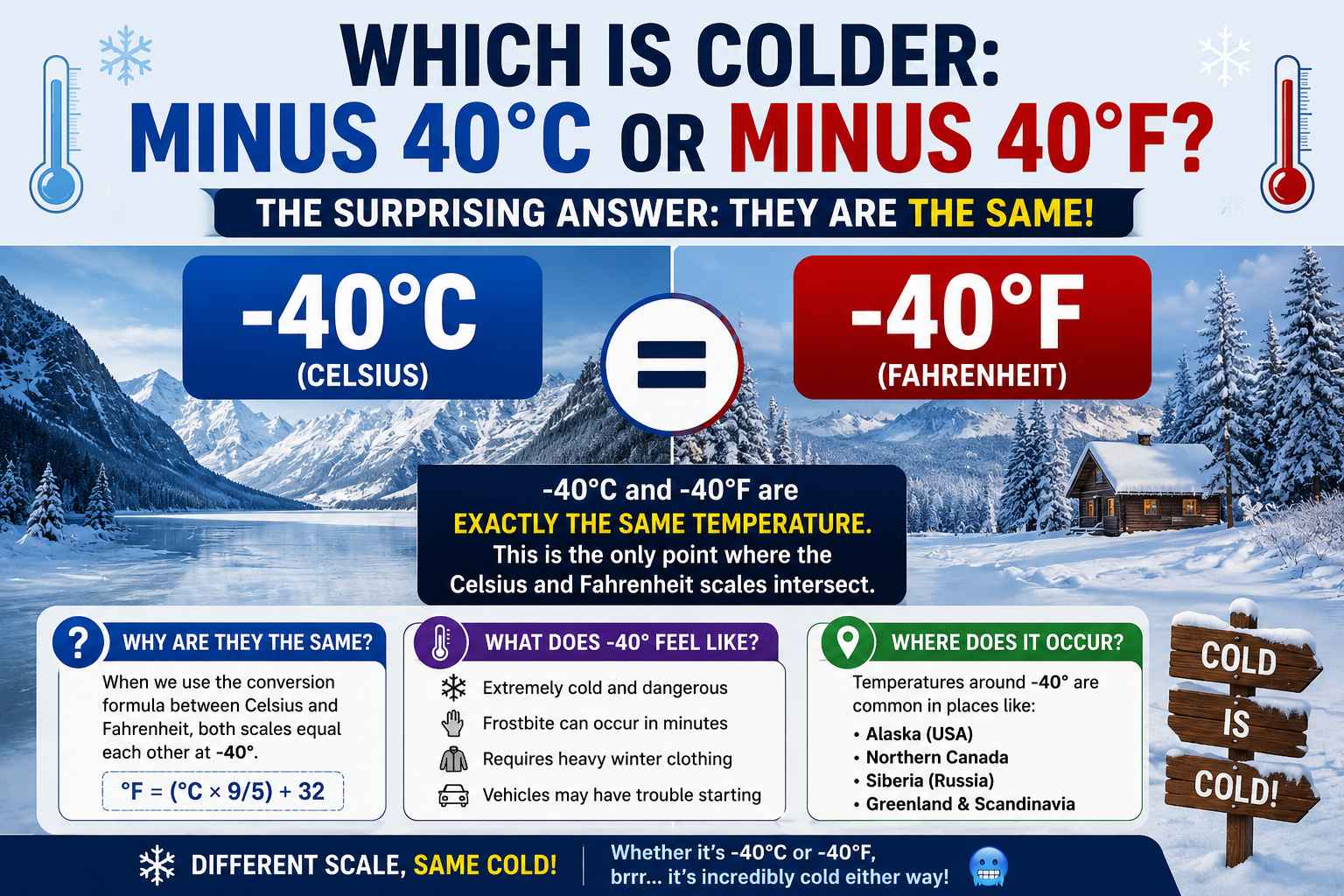
Which Is Colder: Minus 40°C or Minus 40°F? The Surprising Answer Explained
Temperature can be confusing, especially when different measurement systems are involved. One question that often appears in science classes, quizzes, interviews, and online discussions is: which is colder: minus 40°C or minus 40°F?
At first glance, many people assume one must be colder than the other because Celsius and Fahrenheit use different scales. However, the answer is surprising.
Minus 40 degrees Celsius (-40°C) and minus 40 degrees Fahrenheit (-40°F) are exactly the same temperature.
Yes, you read that correctly. At one unique point on the temperature scale, Celsius and Fahrenheit intersect. That point is -40 degrees.
Understanding why this happens requires a basic look at how these two temperature scales work and how they relate to each other.
Understanding Celsius and Fahrenheit
The Celsius scale is used by most countries around the world. It is based on water freezing at 0°C and boiling at 100°C under standard atmospheric conditions.
The Fahrenheit scale is primarily used in the United States and a few other regions. On this scale, water freezes at 32°F and boils at 212°F.
Because the scales have different starting points and different intervals, temperatures are usually different when converted from one system to the other.
For example:
- 0°C = 32°F
- 20°C = 68°F
- 30°C = 86°F
- 100°C = 212°F
However, there is one special temperature where both scales show the same numerical value.
That temperature is -40 degrees.
Also read: Overstimulated Meaning
Why Are -40°C and -40°F the Same?
The conversion formula between Celsius and Fahrenheit is:
F=59C+32
To find the point where Celsius equals Fahrenheit, we set the values equal to each other:
C=59C+32
Solving the equation gives:
C = -40
Since Celsius and Fahrenheit are equal at this point:
-40°C = -40°F
This is the only temperature where the two scales intersect.
What Does -40 Degrees Feel Like?
Whether you call it -40°C or -40°F, it is extremely cold.
At this temperature:
- Exposed skin can freeze within minutes.
- Breathing may feel painful.
- Vehicles often struggle to start.
- Snow remains dry and powdery.
- Outdoor activities become dangerous without proper protection.
People living in parts of Canada, Alaska, northern United States, Russia, and Scandinavia occasionally experience temperatures close to -40 degrees during severe winter conditions.
At these temperatures, even short periods outdoors require heavy winter clothing, insulated boots, gloves, and face protection.
Real-World Examples of -40°C and -40°F
Although many people never experience such extreme cold, it is not uncommon in certain regions.
Northern Canada
Communities in northern Canada regularly experience temperatures approaching -40°C during winter. Because Canada uses Celsius, weather reports often display these readings directly.
Alaska
In Alaska, temperatures can fall below -40°F during cold winter outbreaks. Since the United States uses Fahrenheit, residents are accustomed to seeing temperatures reported this way.
Siberia
Many parts of Siberia frequently experience temperatures colder than -40 degrees during winter months. Some locations even drop below -50°C.
These regions provide real-world examples of how harsh such temperatures can be.
Also read: 25 Mindfulness Exercises to Reduce Stress
Common Misconceptions About -40°C and -40°F
Many people assume that because Fahrenheit and Celsius use different scales, one version of minus 40 must be colder.
This misunderstanding usually comes from seeing different numbers in everyday weather reports.
For example:
- 0°C equals 32°F
- 10°C equals 50°F
- 20°C equals 68°F
Since the numbers are normally different, it seems logical to assume that -40°C and -40°F would also be different.
However, mathematics shows that they represent the exact same temperature.
This makes -40 one of the most interesting points in temperature measurement.
How Temperature Conversion Works
Understanding temperature conversion can help avoid confusion.
To convert Celsius to Fahrenheit:
Multiply by 9, divide by 5, then add 32.
To convert Fahrenheit to Celsius:
Subtract 32, then multiply by 5 and divide by 9.
For most temperatures, the numbers differ significantly.
However, at -40, the calculations produce the same result.
This is why weather experts, scientists, teachers, and engineers often use -40 as a memorable example when explaining temperature conversion.
Why Is This Question So Popular?
The question “Which is colder: minus 40°C or minus 40°F?” appears frequently because it seems like a trick question.
Most people instinctively choose one temperature over the other without realizing they are identical.
It is often used in:
- Science classes
- Educational quizzes
- Job interviews
- Trivia games
- Online discussions
The unexpected answer makes it memorable and helps people better understand temperature scales.
Also read: 175 Funny Questions to Ask
Scientific Importance of Temperature Scales
Temperature measurement plays a critical role in science, engineering, healthcare, weather forecasting, and environmental research.
Scientists use temperature scales to:
- Monitor climate changes
- Predict weather patterns
- Conduct laboratory experiments
- Measure industrial processes
- Track environmental conditions
While Celsius and Fahrenheit remain common for everyday use, scientists often rely on the Kelvin scale for advanced research.
Even so, understanding the relationship between Celsius and Fahrenheit remains important because both scales are widely used around the world.
Also read:- JJMR Site
Interesting Facts About -40 Degrees
Several fascinating facts make -40 degrees unique:
It Is the Only Matching Point
The most famous fact is that -40°C and -40°F are exactly equal.
Extreme Cold Begins Around This Range
Many cold-weather safety guidelines become especially important when temperatures approach -40 degrees.
Vehicle Performance Drops Significantly
Engine oil thickens, batteries lose efficiency, and fuel systems can experience problems.
Frostbite Risk Increases
Without proper clothing, exposed skin may develop frostbite in a matter of minutes.
It Is Common in Polar Regions
Arctic and sub-Arctic locations often experience temperatures near or below -40 degrees during winter.
The Final Answer
So, which is colder: minus 40°C or minus 40°F?
The answer is simple:
Neither is colder. They are exactly the same temperature.
At -40 degrees, the Celsius and Fahrenheit scales intersect, making -40°C equal to -40°F.
Although the two temperature systems usually display different numbers, this unique point is where they meet perfectly. It is one of the most interesting facts in temperature measurement and a great example of how mathematical relationships can produce surprising results.
Whether you see -40°C on a Canadian weather report or -40°F in Alaska, you can be certain of one thing—it is incredibly cold.
Also read:- ENFP Personality
Frequently Asked Questions (FAQs)
1. Which is colder: -40°C or -40°F?
Neither is colder. -40°C and -40°F are exactly the same temperature. This is the only point where the Celsius and Fahrenheit scales intersect.
2. Why are -40°C and -40°F equal?
The Celsius and Fahrenheit scales have different starting points and intervals. When you apply the temperature conversion formula, both scales meet at -40 degrees.
3. Is -40°C dangerous for humans?
Yes. Temperatures around -40°C can be dangerous. Exposed skin can develop frostbite within minutes, and prolonged exposure may lead to hypothermia.
4. Does -40°F feel different from -40°C?
No. Since they represent the same temperature, -40°F and -40°C feel exactly the same.
5. Where do temperatures of -40 degrees occur?
Temperatures near -40°C/-40°F can occur in places such as Alaska, northern Canada, Siberia, Greenland, and parts of Scandinavia during winter.
6. How do you convert Celsius to Fahrenheit?
Use the formula:
°F = (°C × 9/5) + 32
This formula converts any Celsius temperature into Fahrenheit.
7. How do you convert Fahrenheit to Celsius?
Use the formula:
°C = (°F − 32) × 5/9
This formula converts Fahrenheit temperatures into Celsius.
8. Is -40 degrees the coldest temperature on Earth?
No. Some regions on Earth experience temperatures much lower than -40°C, especially in Antarctica and parts of Siberia.
9. Can cars operate at -40°C or -40°F?
Yes, but vehicles may face challenges such as battery failure, thick engine oil, frozen fluids, and difficulty starting without winter preparation.
10. Why is this question often used in quizzes?
The question “Which is colder: -40°C or -40°F?” is popular because it sounds like a trick question. Many people assume one must be colder, but the correct answer is that they are equal.
11. What should you wear in -40-degree weather?
People should wear insulated jackets, thermal layers, gloves, hats, face coverings, and waterproof boots to protect themselves from extreme cold.
12. Is -40°C colder than a household freezer?
Yes. Most household freezers operate around -18°C (0°F), which is much warmer than -40°C (-40°F).
13. What is the significance of -40 degrees in science?
It is the unique temperature where the Celsius and Fahrenheit scales have the same numerical value, making it an important example in temperature conversion.
14. Is water frozen at -40°C?
Absolutely. Water freezes at 0°C (32°F), so at -40°C, water is completely frozen and ice remains extremely solid.
15. What is the simple answer to “Which is colder: minus 40°C or minus 40°F?”
The simple answer is:
Neither. Minus 40°C and minus 40°F are exactly the same temperature.
Author bio:
Hello, I am a professional SEO Expert & Write for us Technology and submit a guest posts on different platforms- we provide a good opportunity for content writers to submit guest posts on our website. We frequently highlight and tend to showcase guests.