
Introduction
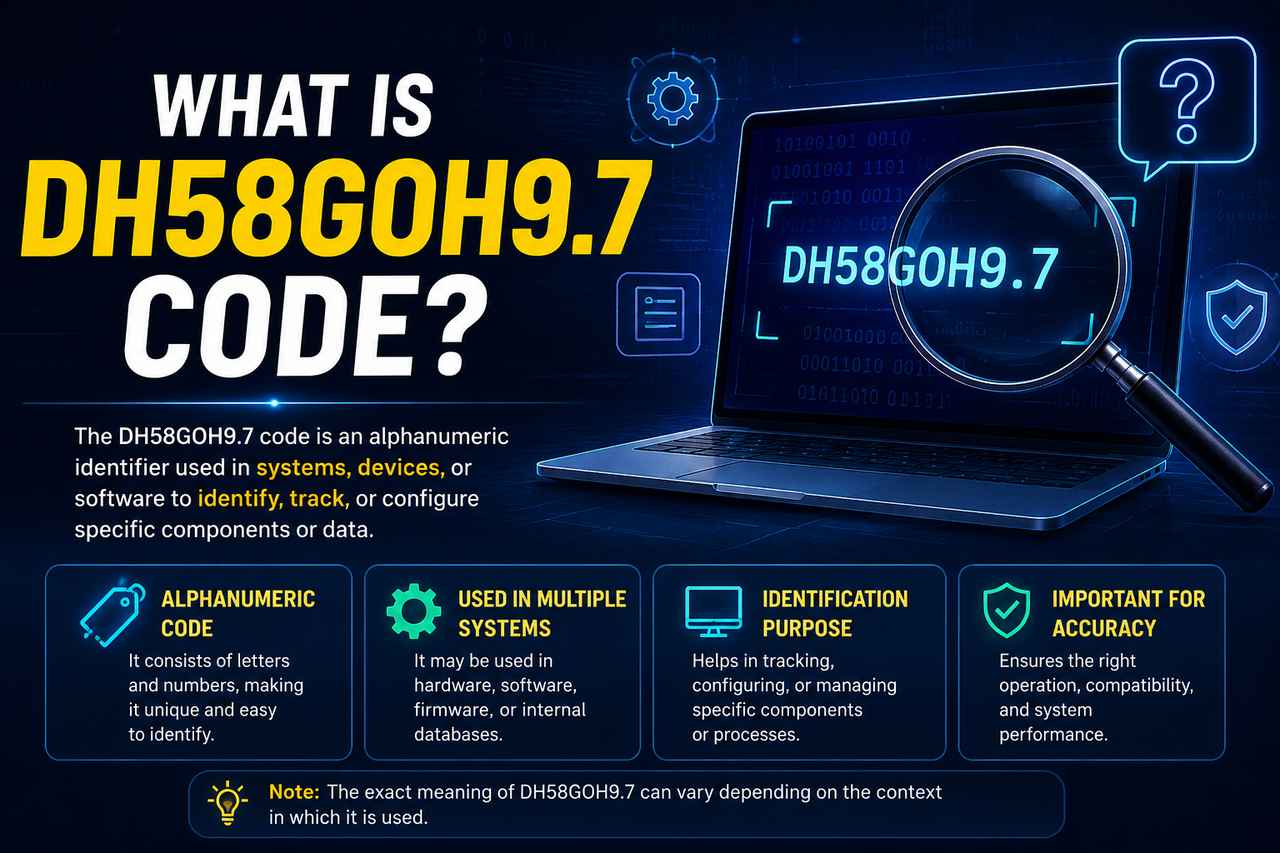
Technology users occasionally encounter odd combinations of letters, numbers, and symbols that do not appear to conform with standard software nomenclature. An example of this is code DH58GOH9.7. At first glance, this may be a software version, a build number, a firmware identifier, a type of internal development label, or some other technical reference.
This code’s atypical nature raises a lot of questions.
What is DH58GOH9.7? Is it a software? Is it a firmware version? Is it some sort of device identifier? Is it a development build? Is it installable? Is it safe? How can the developers of DH58GOH9.7 improve the software, if at all?
These questions are valid, as most of the time, software will have easily identifiable names. Browsers, office applications, media players, and operating systems will have software names that describe their purpose. An identifier like DH58GOH9.7 will not provide that information.
There is little publicly accessible information for the software name DH58GOH9.7, and no informal public documentation exists that would allow it to be classified as a software product for the mainstream consumer market. There are many interpretations of the software in question on several webpages. Some treat the software in question to be internal or experimental, while others make more specific claims that do not cite any official developers.
Consequently, the most feasible way to analyze the code DH58GOH9.7 is to look at what such identifiers may represent. We will analyze the structure of software code and examine the types of obscure code identifiers, how to trace them back to their source, and what reliability improvements can be made to internal software builds if this is, in fact, a genuine development.
This document answers such questions comprehensively.
What Is the DH58GOH9.7 Code?
The DH58GOH9.7 code does not seem to represent a software brand name. Instead, it seems to represent a name or a label.
Such a name might refer to any of the following, to name a few:
- A software build
- A firmware version
- An internal development reference
- A test build
- A module
- A package
- A backend component
- A placeholder development name
- A software reference
- A version-specific technical reference
Due to the lack of development or manufacturer documentation, the meaning for the segments of the name will remain unknown.
One should not presume that the segments of the code have a universally accepted meaning.
For explanation, the 9.7 could represent a software version number. More likely, it represents a release, revision, branch, or something else in an internal numbering system. Without system documentation, the meaning of the segments DH, 58, GOH, or 9.7 will remain unreported.
This is important when looking at a new software product.
Having a name that looks technical does not provide an explanation of the functionality of the software.
Also read:- Free Enneagram Test Online
What is the Reason for DH58GOH9.7 Looking Like Software Code?
The identifier has a combination of letters, numbers, and a decimal.
This type of combination is similar to schemes used in software development.
For example, developers will often use structured combinations to indicate the following:
- Versions
- Builds
- Releases
- Test environments
- Development branches
Based on the above, a package a consumer might see, for example, “Example App,” will not make sense to most people. Its internal build that makes the “Example App” work will, however, make a great deal of sense to the developers building it.
This means that we cannot determine whether DH58GOH9.7 is a complete application or just one part of a bigger system by its name alone.
Is DH58GOH9.7 a Real Software Product?
This is a very important question.
Presently, very little information about DH58GOH9.7 can be verified, and there are no clear connections to a known, commercial software company, official software product, or documented developers from reputable sources.
Some information online has described it as an internal or hypothetical software code. Other sites have referenced its possible features and types of usage, but due to the inconsistency of these descriptions, it is better to avoid treating any of these interpretations as confirmed.
This does not mean the code is a fabrication.
It may be one of the following:
- A code of an internal system
- A private app
- A firmware
- A dev build
- A test build
- A component of a system
- A software package with limited documentation
The best way to determine what it is, is to check the source where the code was found.
Where Will You See DH58GOH9.7?
The code can be found in numerous, unfamiliar places.
1. Software Installation Packages
It is possible that DH58GOH9.7 can be found as a name in a software installation package. For example, a downloaded file could have a version like string as part of the filename. This would not mean that the application as a whole is named DH58GOH9.7. It may be part of an internal build number for that specific file.
2. System Settings of a Device
Some devices have a build or firmware version displayed in the system settings.
A technical identifier can be found in different subsections under:
- About Device
- Software Information
- System Information
- Firmware
- Build Number
- Developer Information
If you found DH58GOH9.7 in these subsections, searching the device manufacturer may be more helpful than searching the identifier.
System Logs
Logs can contain a lot of unfamiliar codes that are especially useful to developers and advanced users.
Some examples of components that logs can contain are:
- Application versions
- Build IDs
- Module names
- Error identifiers
- Package names
- API versions
- Debug references
If you encountered DH58GOH9.7 in a logs system, it is more likely that you viewed a component identifier as opposed to a launchable application.
Downloaded Packages
Certain third-party packages can contain uncommon names, seen often with:
- Beta software
- Development builds
- Modified applications
- Firmware files
- Testing packages
- Repackaged software
Due to the variety of third-party packages and the possibilities of modified software, the origin of the package is critical.
Developer or Testing Environments
When developers are creating software, the use of temporary names is often seen.
An internal development version may never become a public product, leading to a situation in which an identifier appears in a technical context without a corresponding consumer-facing web resource.
Understanding the “9.7” Part of DH58GOH9.7
The last 9.7 of DH58GOH9.7 appears to be a version number.
An instance of a version number from a software may be seen in the following formats:
- 1.0
- 2.5
- 3.1
- 10.4
- 9.7
Presence of a version with a decimal does not mean that the 9.7 is a major/minor version.
As there is no official documentation, it is prudent to refer to 9.7 as a version-like component, as opposed to describing its meaning.
Also read:- Compatibility Test Explained
Could DH58GOH9.7 be an Internal Software Code?
Yes, that is one possible answer.
Large software systems contain many internal, individually unmarketed, internal, software systems.
For example, a company could have:
- A main application
- A database
- An authentication service
- A reporting service
- Background processing
- Mobile
- A testing branch
Internal identifiers can exist for each component.
Hence, it can be said that the code DH58GOH9.7 can belong to one of the internal components.
However, without further references, this can only be considered as a possible answer.
What are the advantages of using unconventional identifiers?
There are many advantages of using a technical identifier.
Facilitates Distinguishing Versions
Identifying versions is a crucial part of the software development process.
Version identifiers reduce the chance of confusing different builds.
Facilitates Reporting of Errors
Build variants can be used to report problems encountered during testing.
Facilitates Version Control
Version identifiers simplify internal control of software components.
Facilitates Bug Tracking
Version identifiers help relate logs to a specific version of a component.
Facilitates Version Identification on a Client’s Machine
Organizations can easily identify the installed version on a client’s machine.
Technical Code DH58GOH9.7 Naming Convention vs Commercial Product Naming
There is a huge contrast between naming a software product and a technical identifier.
A software product name is a build for people.
It may be:
- Memorable
- Easy to say
- Easy to spell
- Easy to find online
- Good for marketing
Usually, a technical identifier is made for systems.
It may be:
- Unique
- Concise
- Organized
- Version-specific
- Hard to memorize
DH58GOH9.7 is likely to resemble the second group more closely.
For this reason, it should not be considered a typical consumer application.
What Could the DH58GOH9.7 Software Possibly Be?
Since the software’s identity is not publicly disclosed, it is preferable to discuss possible categories instead of a specific use.
Some examples may be:
Software Testing
It may be a coded build used to test features before they are released to the users.
Firmware Management
Some systems use technical identifiers for specific firmware versions.
Internal Business Systems
It is possible companies use coded names for their private applications.
Backend Components
It may refer to a service that operates in the background of a system.
Development Builds
It is possible a version code may be used to determine a specific build for software.
These are some of the possible examples of what the identifier DH58GOH9.7 may be used for. It is important to understand that these are not concrete examples of what this code does.
Ways to Determine What DH58GOH9.7 Really Is
If you have come across the code for yourself, the best thing you can do is to research the context of where you found it.
Step 1: Identifying Where You Corresponded or Saw It
Ask yourself:
Where did you see DH58GOH9.7?
Was it:
- On a phone?
- On a computer?
- In a browser?
- In an app?
- In a downloaded file?
- In system settings?
- In an error message?
- In a log?
- On a website?
The location might provide more context than the code.
Step 2: Search for a Developer Name
Check if the same screen or file shows:
- Developer name
- Company name
- Website
- Copyright
- Publisher
- Manufacturer
Legitimate software packages usually have some form of identifiers.
If the code is accompanied by a known developer, check that developer’s official documents.
Step 3: Look at the File Attributes
If DH58GOH9.7 is associated with a file, check the attributes for that file.
Depending on the operating system, you might find:
- Publisher
- Product name
- File version
- Copyright
- A digital signature
- Creation info
A valid digital signature can provide useful info about the publisher.
Step 4: Check Original Source
Where did this software originate?
This is extremely important.
Generally a file downloaded from an official developer site is easier to verify than a package from an unknown third-party download page.
If you are unsure of the origin of a file, do not install it just because the filename looks technical.
Step 5: Verify Digital Signature
On some operating systems, a digital signature can indicate whether the file was signed by a known publisher.
Be more cautious if a file has:
- No Publisher
- No Signature
- Unknown Origin
- Permissions that seem out of place
Is DH58GOH9.7 Unsafe?
Nothing can be determined about the safety of a software file from its identifier alone. Just because a name appears random does not mean it is malicious. Similarly, a random name does not make a code safe. Trust is built by many factors, including:
- Source
- Publisher
- File Integrity
- Digital Signature
- Permissions
- Behavior
- Security Reputation
- Installation Method
This is the main reason that users should not make a safety call based on a name alone.
What should you do when you encounter unknown software?
Take a cautious approach if you encounter a file with DH58GOH9.7.
Check the Source
Try to determine who provided the file.
Check the Publisher
Try to verify that the file publisher is a known company or developer.
Perform a Scan
Do not open the file until you have scanned it with a trusted security application.
Review Permissions
If an application is requesting permissions that do not relate to its intended purpose, you should be cautious.
Check for Evidence
Try to find evidence of the application from the developer, or find official documentation.
Do not trust modified software.
Also read: MailerLite Login Guide
Why are unofficial downloads a bad idea?
Some third-party websites host software that is modified or repackaged.
These can contain:
- Unwanted Software
- Adware
- Tracking
- Modified Code
- Malware
- Outdated Dependencies
For this reason, downloading software from the official publisher is preferred.
What does DH58GOH9.7 mean? Could it be Malware?
There is nothing indicating that this code means Malware, or that it is not safe.
The identifier appears random.
Many legitimate software programs have features that appear to be random to the typical user.
As an example, software programs were found to have features that contained:
- Characters
- Digits
- Version information
- Hash-like strings
- References to builds
A component’s name may appear as DH58GOH9.7. In this case, the question should not be:
“Does DH58GOH9.7 appear to be suspicious?”
However, the question may be:
“From where did DH58GOH9.7 appear, who originated it, and what does the file or component do?”
Some Misconceptions About DH58GOH9.7
Myth 1: The Component Name is the Software Name.
Not always.
The string of characters may be an internal name.
Myth 2: DH58GOH9.7 is a Name for Version 7 of the Software.
Not always.
It may be part of some other enumeration.
Myth 3: If the Name is Strange, it is a Virus.
Not always.
Many legitimate systems have strange names.
Myth 4: All the Websites Discussing DH58GOH9.7 are True.
Not always.
When there are no official documents for a component, claims may be speculative or contradictory.
Myth 5: You Must Install it to Find Out What it Does.
Not always.
The Unknown software must be checked before installation.
Importance of Correct Identification.
Determining the correct name for the software is important for several reasons.
Security
You must determine whether a file can be trusted.
Compatibility
Software may have different hardware or operating system requirements.
Version Control
Knowing the precise version is essential to determine the build.
Troubleshooting
Knowing the exact build can help diagnosis.
Support
A legitimate developer may ask for the exact software version when investigating a problem.
What Information Is Important?
To associate DH58GOH9.7 with something, more context is better.
Some valuable context is:
- Code
- Software Name
- Name of Device
- Name of OS
- Name of File
- File Type
- Name of Developer
- Name of Publisher
- Download Site
- Error Message
- Location
- Relevant Screenshot
- Software Version
- Date of Installation
Context is key for making sense of the identifier.
Is There Potential to Improve DH58GOH9.7?
Assuming DH58GOH9.7 is something other than a fictitious piece of software, there is a lot of room for improvement for the developers of this project.
Improvements will be based on function of the software, but some more common improvement areas are:
- Performance
- Security
- Stability
- User Experience
- Compatibility
- Documentation
- Error Handling
- Installation
- Updates
- Accessibility
- Integration
It is reasonable to assume the statement “improve DH58GOH9.7 software” is a placeholder for a prospective product improvement statement rather than a comment on formally agreed next steps.
What Improvements Can Be Made to DH58GOH9.7 Software?
The first improvement area should be performance.
Some of the more common reasons software performs poorly are:
- Inefficiency
- Excessive Memory Consumption
- Poor Database Queries
- Excessive Background Processes
- Large File Size
- Network Latency
- Poor Resource Management
Profiling and benchmarking are useful to identify performance issues and poor resource management. Software should be measured before making performance assessments.
Automated testing helps identify these problems early in the development cycle.
3. Improve Startup Time
If DH58GOH9.7 is a user-facing application, the speed of the application greatly enhances user experience.
Some ways to speed up application startup are:
- Load essential resources only
- Postpone uncritical work
- Streamline the initialization process
- Eliminate unnecessary dependencies
- Preload resources
Users generally favor applications that they can start and use in the shortest time.
4. Improve the User Interface
If DH58GOH9.7 has a graphical interface, one of the most important aspects of the development process is usability.
A good user interface is:
- Simple
- Uniform
- Fast
- Easy to use
- User friendly
- Even beginner users
It’s a myth that complex, technical applications have to be hard to use.
With proper interface design, advanced features become simple to access and use.
5. Improve Error Messages
Poor error messages make problem resolution very difficult.
Instead of showing a generic message, such as:
“Error occurred.”
an application should explain the error and give some resolution steps.
An error message should generally explain the following:
- What the error was
- How it happened
- What the user can do
- Does it require Admin access
- Where to find more help
With proper error processing, support requests can be greatly reduced.
6. Enhance Security
Security is an ongoing concern during development.
Some measures include:
- Secure authentication
- Strong encryption
- Improved data handling
- Permission controls
- Secure update processes
- Dependency monitoring
- Vulnerability testing
- Logging
- Security monitoring
Security should not be retrofitted.
7. Enhance Software Updates
A reliable update system helps the long-term maintenance of software.
Subsequent releases of DH58GOH9.7 may incorporate the following:
- Version numbers
- Release notes
- Checks
- Rollback
- Integrity
- Secure download
Users would appreciate knowing what changed in a release.
8. Enhance Documentation
A common frustration with software is a lack of documentation.
To address this, documentation may contain:
- Installation and configuration instructions,
- API documentation,
- System requirements,
- Security and troubleshooting information,
- Version histories,
- Frequent questions
Clear documentation is especially helpful for a software package with an unclear identifier such as DH58GOH9.7.
9. Enhance Compatibility
Ideally, software functions reliably in all supported environments.
Developers should document and communicate:
- Supported operating systems and browsers,
- Hardware and library requirements,
- Supported architectures,
- System requirements
Compatibility testing should be done before major releases.
10. Enhance Testing
An adequate testing process decreases bugs.
Some testing methods may include:
- Unit Testing
- Integration Testing
- Performance Testing
- Security Testing
- User Acceptance Testing
- Regression Testing
11. Make Accessibility Improvements
Wherever applicable, make sure to consider accessibility in DH58GOH9.7.
Some examples of possible accessibility features include:
- Keyboard navigation
- Screen-reader compatibility
- Easy to read text
- Readable error messages
- Adjustable text size and contrast
- Descriptive labels
A primary benefit of accessibility is having more potential users.
12. Make Integration Improvements
Fully autonomous software systems are a thing of the past.
Your future iterations design should include possible integrations with:
- APIs
- Cloud applications
- Databases
- Authentication systems
- Analytics
- Business applications
However, every integration should be well documented and safely implemented.
13. Make Data Handling Improvements
If DH58GOH9.7 handles any amount of data, the focus should be on:
- Validation and accuracy
- Encryption
- Backup and retention
- Access control
- Error recovery
Poor data handling introduces a host of security and performance issues.
14. Make Logging Improvements
While good logging is integral to a good development process, it becomes especially important when error states are encountered.
Helpful logs cover the following:
- Timestamps
- Component
- Error type
- Request ID
- Version
- System state
Do not log sensitive data unnecessarily.
15. Make Improvements to Future Version Naming
The more clear DH58GOH9.7 is as an internal or technical name, the more clear naming future versions would be.
A good version naming system should identify:
- Major releases
- Minor releases
- Patches
- Builds
- Platforms
- Development states
For example, a project could use a consistent scheme such as:
1.0.0
The important thing is system consistency.
Also read:- 175 Funny Questions to Ask
How to Make Future Improvements to DH58GOH9.7 Software
Future improvements should be systematic and follow a structured process instead of being random software features.
A pragmatic development roadmap could look like this:
Phase 1: Identification
Precisely identify what the software does and its users.
Phase 2: Measurement
Performance, stability, and security information are gathered.
Phase 3: Problem Identification
Weaknesses are identified.
Phase 4: Prioritization
User impact and risk are considered when determining the order of weaknesses.
Phase 5: Development
Weaknesses are improved in controlled groups.
Phase 6: Testing
New builds are extensively tested.
Phase 7: Deployment
Updated builds are released in a careful manner.
Phase 8: Monitoring
Performance and feedback are monitored.
Phase 9: Maintenance
Bugs and security weaknesses are continuously fixed.
These steps help evolve an unclear software build into a finished product.
Actions Users Should Take If They Come Across DH58GOH9.7 Software
If you come across a downloadable file named DH58GOH9.7, do not trust the online claims of its benefit, and do not install it.
Instead, you should do the following:
- Identify the source
- Check the developer
- Verify the file
- Scan the file
- Check the permissions
- Look for official documentation
- Look for trustworthy user reports
- Create a backup if the software is being directly installed on the system
- Avoid modified packages
- Install the software only if you are sure of the source
These steps should be followed especially when there is a lack of clear documentation regarding the software.
What Businesses Should Do If The Identifier Is From An Internal DH58GOH9.7 System
If the identifier is of an internal system of the business, proper documentation should be maintained.
Documentation may include:
- Owner
- Developer
- Version
- Release date
- Supported systems
- Dependencies
- Security status
- Known bugs
- Change history
- Backup procedures
- Recovery procedures
This ensures that maintaining the internal system isn’t a difficulty.
When there is a lack of documentation, internal systems can become hard to maintain, especially with the changes to developers and administrators.
The Significance of Documentation for Obscure Software Code
Documenting the definition of an identifier is essential for communicating its value.
If a decipherable identifier relates to an internal asset, a header, and/or documentation should be created.
Example
Identifier: DH58GOH9.7
Internal Product: Yes
Build Version: 9.7
Production Environment: Testing
Responsible Party: Dev Team
Date of Release: Internal Documentation
Current Status: Testing
Searching for DH58GOH9.7 May Yield Answers
Yes, but results should be critically evaluated.
Search Results May Contain:
- User experiences
- Tech talks
- Documentation
- Download links
- News articles
- Filler forum posts
- Speculation
If there is minimal to no documentation for an identifier, the results are likely to be guesswork.
Always Separate the Speculation from:
Known Facts
Documenting for Security Purposes Is Most Important
Why Information for DH58GOH9.7 Is So Varied
Limited Documentation
Limited documentation from the official source results in secondary sites filling the gaps with speculation.
SEO Related Articles
In some sites, content is created for obscure search terms, and in doing so, may provide no relevant or accurate information.
Different Software Systems
An identifier may have separate meanings in different software modules.
Copying of Content
One site may copy and paste another site’s content which has no credible sourcing.
This is why the repetition of information should not be used for sourcing.
Proper Research for DH58GOH9.7
Utilizing a hierarchy of sources.
First Priority: Official Developer
Look for official documentation or product info.
Second Priority: Manufacturer
If the identifier is related to hardware, check the device manufacturer.
Third Priority: Technical Documentation
Focus on manuals, release notes, repositories, and support documentation.
Fourth Priority: High Quality Technical Sources
Utilize quality technology publications when applicable.
Fifth Priority: Blogs and Forums
While they can provide helpful insights and experiences, do not consider them authoritative sources.
What If You Have DH58GOH9.7?
Don’t panic.
First try to figure out where you are seeing it.
If it is:
In Settings → About Device → Software Information, it could be a firmware or build number.
If it is:
In Application information, then it could belong to an application you have.
If it is:
In a file you have downloaded, look into the publisher and the file’s source.
If it is found in:
A system log, it could be an internal part.
Context is key.
What If You Found DH58GOH9.7 After Installing an App?
Try to remember what you installed last that may have triggered the identifier.
Ask yourself:
- What is the source of the app?
- Was it directly downloaded from an official store?
- Did it request any odd permissions?
- Did your device start acting differently?
- Is there a developer you can recognize?
- Is deleting the app the normal process?
If the identifier showed up after you downloaded an app from an unofficial source, do a system security scan and look into the source of the app.
Can DH58GOH9.7 Be Removed?
Since the exact nature of the identifier is not made known to the public, there isn’t a single answer that covers all scenarios.
If it is a regular application, then it may be an application that can be removed.
If it is part of a firmware or a component of the system, then it likely isn’t removable and it isn’t recommended to try to remove it.
Just because something goes by an unfamiliar name doesn’t mean it needs to be uninstalled as a system component.
First figure out what it belongs to.
Final Thoughts
The DH58GOH9.7 code is understandably interesting as it doesn’t follow the conventional format for naming software products.
With current public data, we cannot confidently place DH58GOH9.7 as a specific consumer application. Data available on the internet is inconsistent, referring to it as a name for a potential internal, experimental, or iteration-based software. In the absence of formally published documentation to reference a specific developer or a specific rationale, we must refrain from stating any possibilities as certainties.
The best way to understand DH58GOH9.7, is in the context in which you found it.
If you seen it in a device, it may be build or firmware related. If you found it in a application, it may be package or application version. If you found it in a system log, it may be named as part of the internal software.
You cannot assume safety or danger of any software just by its name. Safety can only be determined by its source, publisher, digital signature, permissions, behavior, and other factors.
For the developers, assuming DH58GOH9.7 is a legitimate software project, you have a long way to go with performance, security, reliability, UX, documentation, testing, and versioning.
The main lesson is to not unreasonably judge a software component when you come across one.
Always check the source, the specific component, the distributor, as well as authoritative documentation before making any alterations or installations.
It is possible that the meaning and purpose of DH58GOH9.7 become more known and understood over time due to additional published information. At this time, however, the best way to handle this identifier is as an unverified technical identifier, and not as any legitimate commercial software.
Author bio:
Hello, I am a professional SEO Expert & Write for us Technology and submit a guest posts on different platforms- we provide a good opportunity for content writers to submit guest posts on our website. We frequently highlight and tend to showcase guests.